
6 Sjöar - My First Marathon
Race report, going beyond, fuelling and dialogues with the self

On the 19th of August, I ran my first marathon, as part of the beautiful 6 Sjöar / 6 Lakes race in Fjällnora, located in the Uppsala region of Sweden. This was, without a doubt, the most picturesque and exciting race I have ever had the chance to participate in. I have been training for it for just over two months, following a sub-4 hour marathon training plan from CaffeineBullet as recommended by the incredible Sarah Pemberton, who I am grateful to be able to call my friend and running coach. Given that I am on week 10 of the 16-week plan, and travelling has made following it to a T challenging over July, the primary goal was to just finish the race this time. All hopes of a sub-4 hour marathon evaporated as the first part of the race took us through narrow trails in a forest, where we were often forced to walk. I say we, as I ran the race with Ed Cator, the Man Lacking Any Social Media Presence. Ed is one of the most interesting people I have met over time in Cambridge, and I am grateful that I can call him my friend. Ed is a cross-country runner, duathlete, triathlete, modern pentathlete and a swimmer (including open water and channel relay swimming), and those are only the sports he has competed against the Other University over the previous year. He is also a law graduate and an endless source of dad jokes and cultural references. He ran the race after having a combined six hours of sleep over two nights. His means of carb-loading were sourced from an Irish pub in the south of Sweden. He is truly a source of inspiration and as well as perspiration.
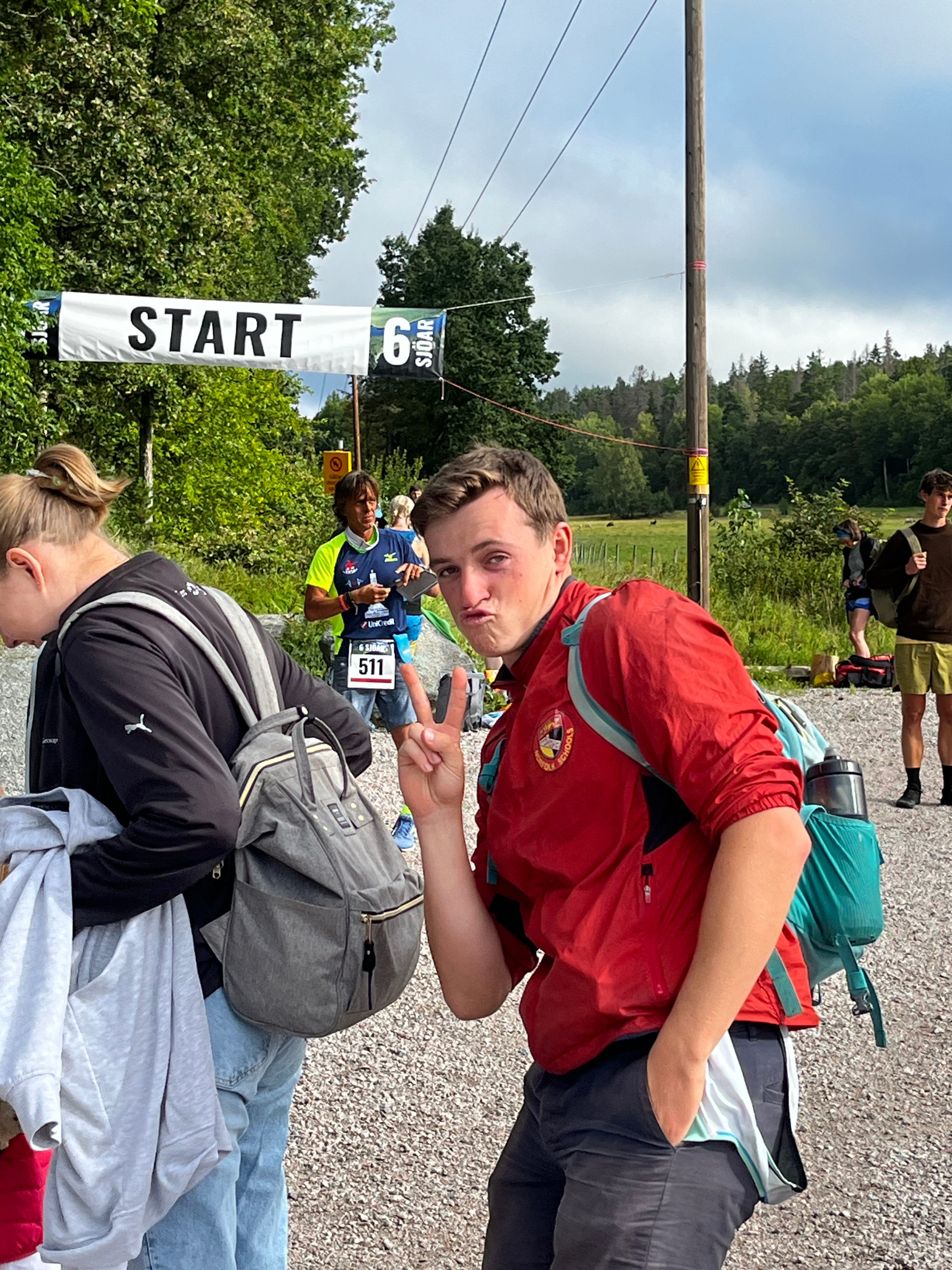
(Pictured above: a sleep-deprived, but excited Ed Cator)
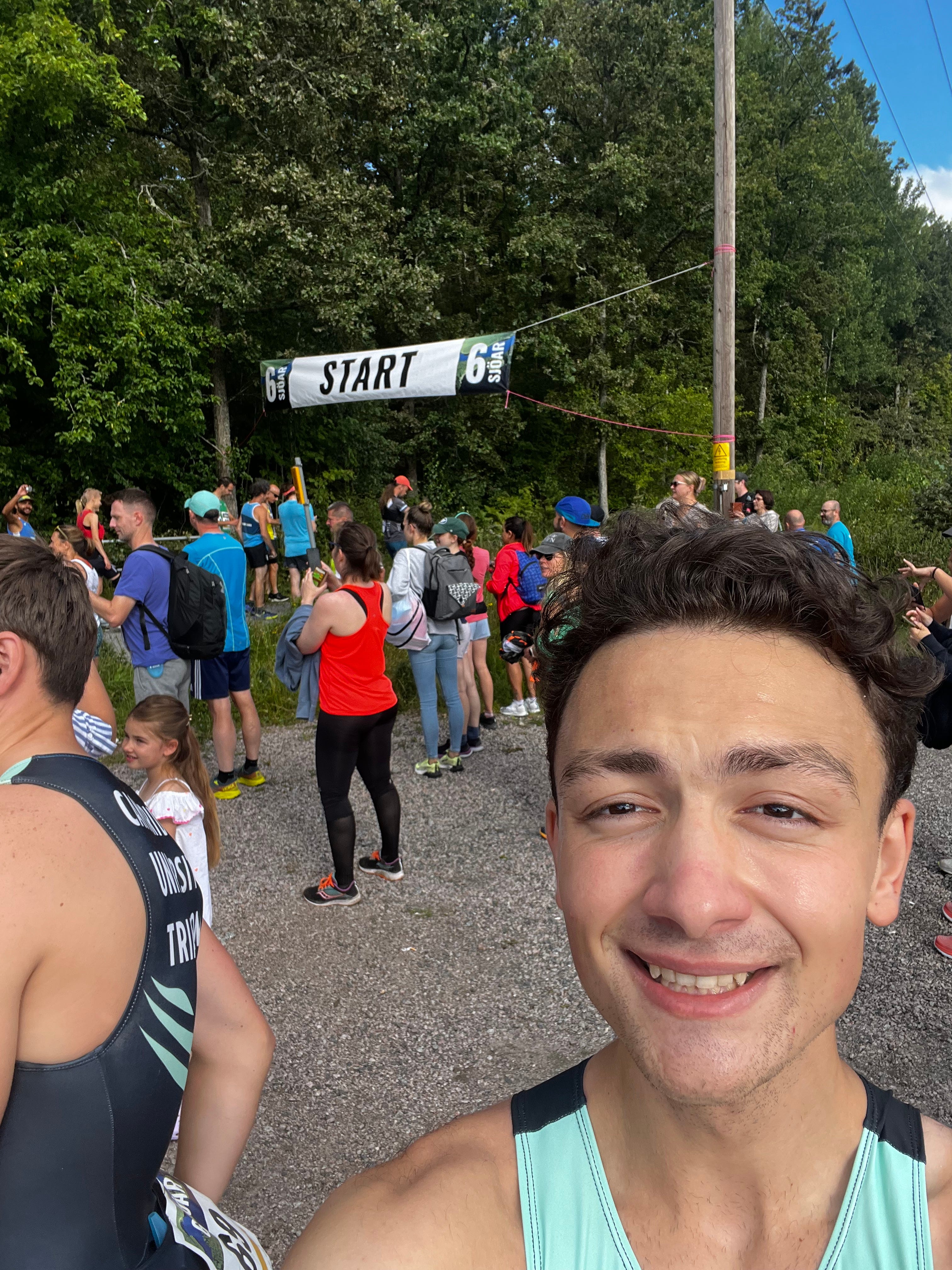
The first ten kilometres flew by, being an hour in, my strategy was to keep myself to an easy pace for the first half of the race, between 6:00 and 6:30 per kilometre. This was definitely doable, but as I have never run more than 26 kilometres in a single session, and even then I bonked, I did not know what would come after the twenty-first kilometre. Two and a half hours in, the half marathon was done, and part of me would have been okay to walk away afterwards - a solid, albeit easy, weekend run. Alas, the second half remained.
Water stations were dotted along the route every three kilometres. I brought along a single gel for the entire race, so seeing power gels with different flavourings at each station was a relief. I was used to more calorific gels though (mine have 60g of carbs vs the 20 in the sachets that were offered), which made pacing them a challenge and during kilometres 24-37, my fuelling was definitely suboptimal. I had at least 3-5 gels and a banana, and I stopped for water and electrolytes at every station. Ed was having a great time, despite me becoming less and less conversational as the kilometres mounted. 21-27 were difficult, then 27-29 flew by, and eventually, we hit the big 3-0. Fuelling was a challenge as being conscious about it depends a lot on knowing your metabolic system, and overcoming the primary instinct of just eating or drinking as much as possible. Gels would leave a cotton mouth from how sugary they were, electrolytes helped more than I thought they would. Putting a small bit of pasta in the salad I got the previous night proved to be insufficient carb-loading.
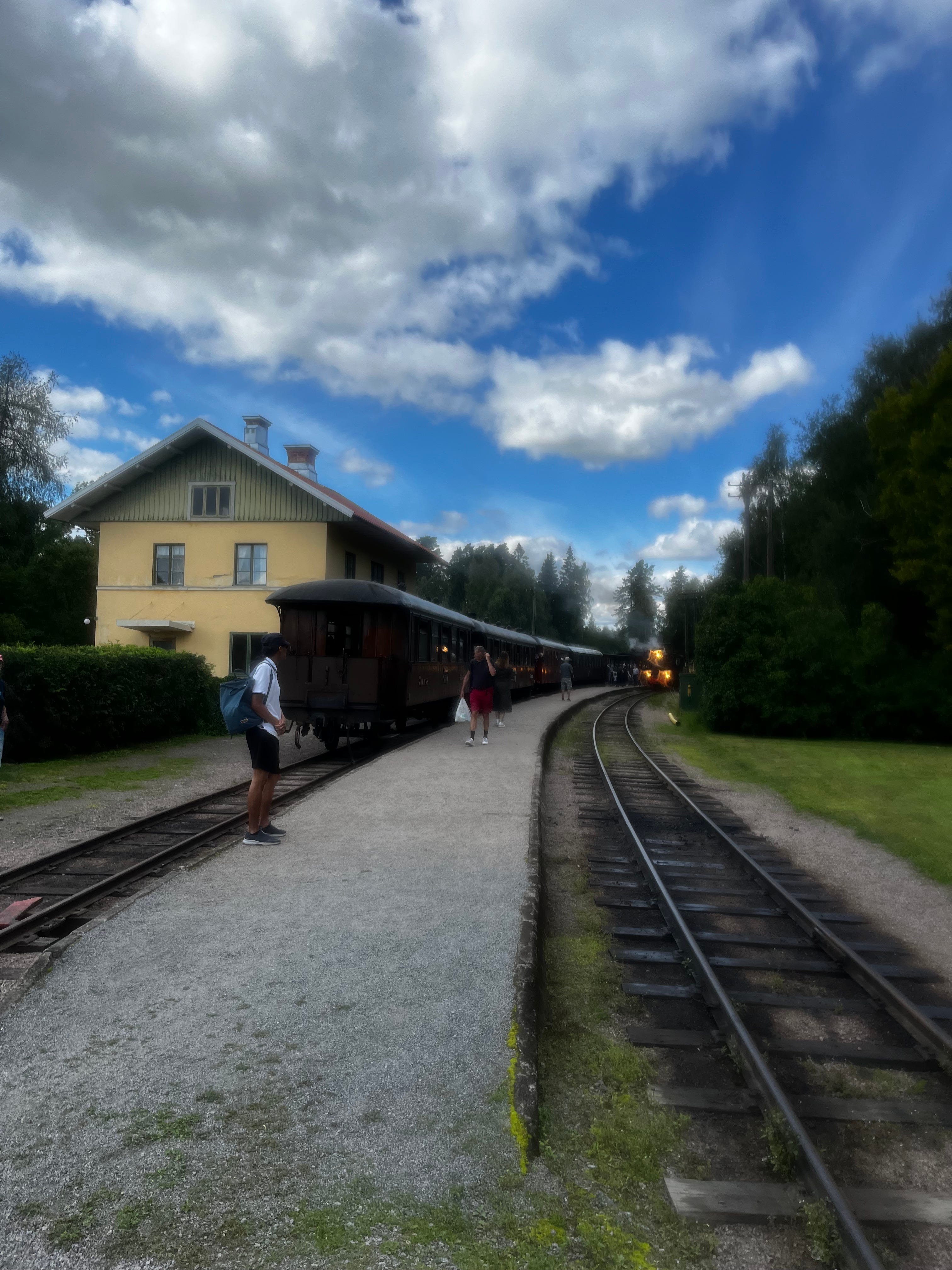
(Above: the museum railway on the route)
I anticipated kilometres 24-37 to be the toughest, specifically the early 30s. Pains started appearing in my thighs in places where I had not felt pain before. As Gergo predicted, a marathon is about perseverance and simply deciding to not do anything but run. This was not unfamiliar, and Ed was plenty helpful in pulling me out my head. At a point, I started thinking through the journey that had put me on this path. Without going into too much detail, as a child I hated running, and I could not understand why anyone would willingly run multiple times a week at inconvenient times. I did orienteering for two years, but I was too unhealthy to run, instead choosing to walk and enjoy navigating forests. When we were made to run in primary school, I always skipped the final lap or two – why warm up if I was going to be the goalkeeper anyway? This perspective remained during the time that my BMI was closer to 30 than 20. Then, after the first big weight-loss journey in Spring 2016, I started running morning 5Ks in Budapest before I could afford good shoes. Then, countless nighttime 10Ks during uni application season, lockdown runs to substitute going to the gym, 9Ks-every-morning for a month in 2020, the fascial injury that set me back for months in winter 2020-21, it was all about re-building again and again. The first half marathon in London in 2021, before I knew what fuelling during a race would mean, then again, re-building endurance in 2023. It is fair to say that I’ve been the most consistent this year, having run at least once every week bar two recovery weeks. If I do not run, my mental health, productivity, self-perception and drive to perform all take a hit. I hate how addicted I have become, but at the same time, I have never regretted going for a run.
These memories came flooding back during the thirties. Ed kept a mantra that the final five kilometres don’t count anyway, so it’s realistically only 37.2km, and that we would just keep chomping away at the kilometres. At every kilometre sign, we would say ‘chomp’. This was more helpful than I would have ever thought. The number of people walking along the route started to increase, particularly on uphill parts. People would cheer us on, the scenery and the terrain would change, and going to concrete from soft forest soil was not something I enjoyed, but it was just the way the course went. I thought back to the 13-year-old version of myself who, deep down, had always wanted to overcome his fears of running wanted to become fit. The 13-year-old who was greeted with 'hey, fatty’ every single morning in primary school. The memories went deeper. I recalled the 9-year-old who had cried once because he couldn’t run nearly as much as he was asked to do. I reminisced about the 8-year-old at his first race, who couldn’t run more than two hundred meters at a time, finishing dead last out of everyone, including all boys from not only his school but all schools in the district.
In my mind, I was running this marathon for all of them. By the time we hit 33km, I was suddenly over it. Bullying had a massive impact on my self-perception during my teens, going into my early 20s, and it was at this point that I knew I was not that kid anymore. Friends, old and new had been reassuring me for years that I looked good, sporty, fit, etc. but none of their comments did as much as actually doing something that I perceived as something that physically fit people do. While I am grateful all of the compliments I have received over the past years, internal validation just hits different.
Of course, dropping out of the race was not an option. What was different this time compared to either of the half marathons was the lack of music to distract or push me. Earlier this year, I was chatting to one of the best runners of Australia who religiously runs without music. While he made a good case for it, during training, I just couldn’t leave the earbuds at home. In fact, while following various training plans, I started to become acutely aware of just how consistent the release schedules of various podcasts I listen to were. Tuesdays are for These Times, Wednesdays are for Sex Cells, Thursdays are for Talking Counter, Saturdays are for The WAN Show (may have to find a replacement) and Sundays are for The Dishcast. At times, I’d substitute these for music, but I’ve always found that listening to conversations made it easier to keep my pace easy, and most of my runs consisted of easy paces. I did not have music to push me through this time. It was just the stomping of the feet, breathing, the sounds of nature, and distant Swedish cheering.
I told Ed that I’d be happy when we hit thirty-four. It was then that in my mind, I started tracing my usual 12k route back home, thinking where I would be compared to if I just started running that route, trying to find the usual freshness in my legs. Instead, what I found was strain, pain and soreness. Water stations started to be about just getting two cups of water - one to drink and one to pour on myself. Running in a tri suit, the most versatile piece of clothing I own, certainly made the run easier, but I had been running in a tri suit ever since I got my first one in February. Running with the Lord of the Tri Suit, the man who travelled for a month around Europe with only two tri suits, a phone charger and a book, and restricted himself to only spend money on food and beer, it was the only way. I remembered that the 6 Sjöar website admitting that the full marathon was actually about 44km long, so 34-44 seemed like a realistic distance to start getting happy about. As we started chomping away at the final ten kilometres, I started getting pain around my heart, which was pretty scary, and which forced me to walk for a minute a few times during the final 10K. Ed was understanding, and, as we had kept a fairly consistent pace through most of the race, I did not feel any less accomplished.
At the thirty-ninth kilometre, we started to hear the people at the finish point. The closeness turned out to be a mirage, though it was definitely a source of inspiration. There was a British couple ahead of us who we kept overtaking. The individual markers for kilometres disappeared after the 38th kilometre, and they were definitely out of sync compared to what my watch was telling me, so when the kilometre counter hit 40, I breathed a sigh of relief. Thigh pain started to be ubiquitous, and I decided to push it - even if I couldn’t finish sub-4, I was not going to go over five hours.
Ed was correct in saying that the final few kilometres are nothing. Oddly, mental tricks to push yourself work a lot better when you aren’t trying to gaslight yourself but instead you are being gaslit. Forty-one came on my watch, we were doing a solid 5:40/km, then, forty-two. Yes, I pushed to finish the official marathon length, 42.195km, not the race itself, but I was happy. I paused my watch and we slowed down. The final two kilometres followed a concrete road, which again, was uncomfortable, and a guy at one of the turns said that there was only about a kilometre left, which felt like the longest kilometre ever, but we then saw the parking lot, the finish sign, but were not sure about which way to approach it from. After being nudged in the right direction, being clapped for and encouraged, Ed sped off a little, and I wanted to push myself to finish with him. My thighs and calves spasmed, and I almost collapsed two metres away from the finish line, but the two beeps were heard and we were through. The organiser of the race, bearing the least typical Scandinavian name - Magnus Carlson - interviewed both of us, as he did with every finisher. I had so many emotions coming over me, but it just felt odd to be standing still after running for five hours straight. I tried stretching, but it hurt, so we grabbed coffee and some snacks and headed to the lakeside.
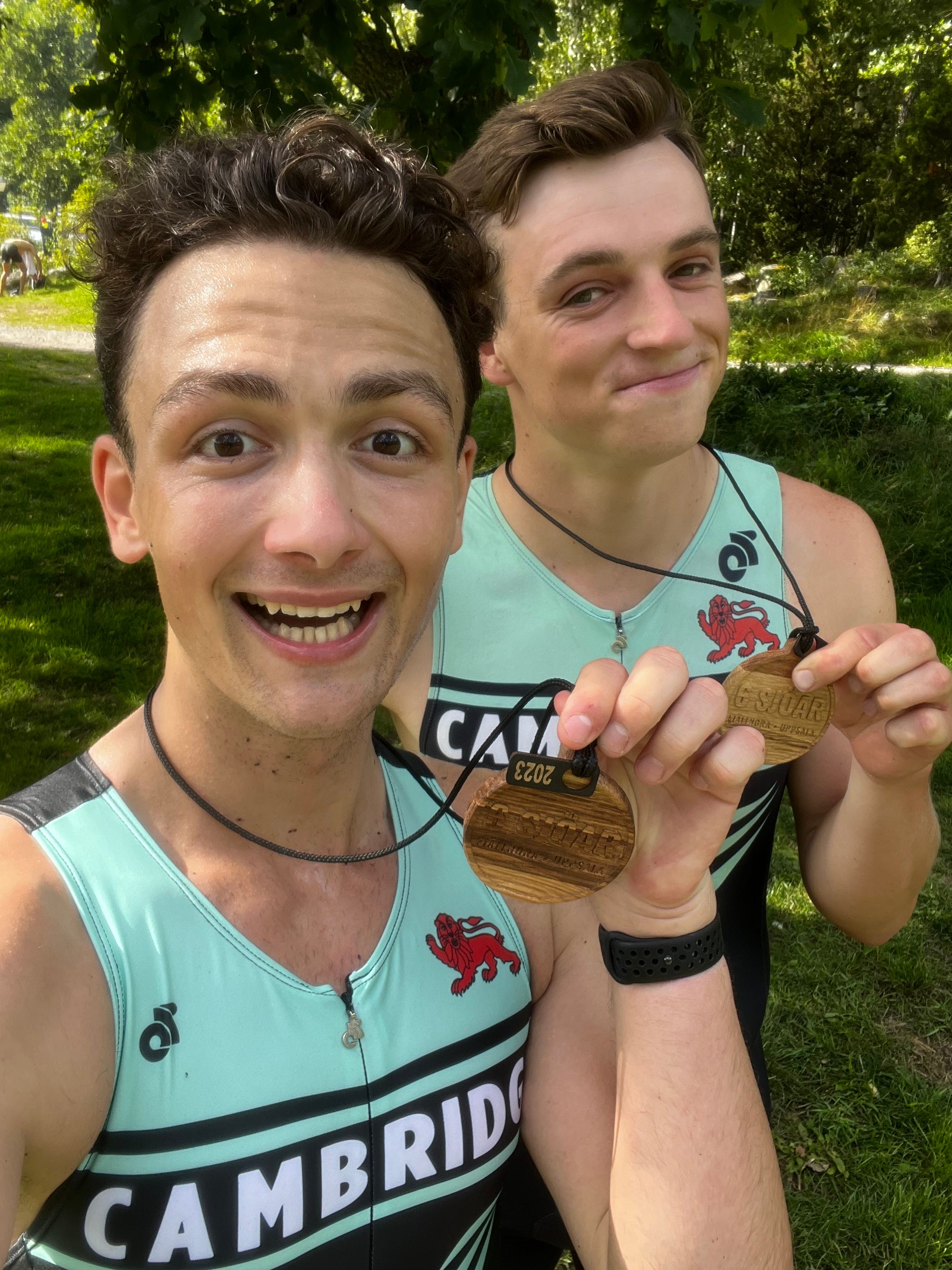
The route took us around six gorgeous lakes, and while we had discussed taking mid-race dips, this was off the table during the run simply because access to the waterside was rather limited. Cooling down mid-race would have also been a terrible idea. Regardless, the plan was always to swim after the race, and, other than the difficult task of bending down and untying my shoes, running waddling into the lake with the elegance of a penguin with digestion problems was a relief. Ed of course, ran in without question. We chatted to some of the other runners, some from South Africa, others from New Zealand, and it made for a lovely social experience. We thanked as many volunteers as we could, I had an afternoon cup of coffee, a few too many cinnamon buns and other snacks, and got on the bus back to Uppsala. We spent the evening discovering various pubs in Uppsala and admiring American cars driven around in the city.
A day later, I am still in a lot of pain, and, just like other major accomplishments, the feeling of having done it has not really hit me yet. I await the moment it does. Until then, I will keep following the rest of the plan. Running a marathon before the age of 25 was the goal, but the Köln Marathon takes place four days before my birthday, and finishing two marathons would be even cooler.
Thanks for this piece. I've never run more than 10K or so, but the idea of getting with the program as regards the differences of each stage of difficulty is helpful, and maybe i'll get beyond 10 one day. As for your penguin, i once ran down a mountain way too fast, for at least a km or more, after lunch during a 48 hr hike. I completely lost my quads eventually, and when we reached a plain I was so at my limit could only continue by walking backwards for a while, with 6 hours climb still to go. the goats just looked on as i passed. However, here's always another source of motion in reserve!